A kitchen in Surry Hills with an ABE extinguisher mounted next to the deep fryer has already failed the AFSS. The agent doesn’t match the hazard. The service tag could be a week old, and it wouldn’t matter.
That’s the real test of an Annual Fire Safety Statement in NSW: whether what’s installed matches what’s listed on your Fire Safety Schedule and the standard that governs it. Seven extinguisher types meet AS 1841. Most Sydney buildings need a mix of two or three of them.
What follows is how a site walk works in practice. Which extinguisher belongs where, and which defects keep showing up against AS 2444 and AS 1851 when the inspection actually runs.
The Six Fire Classes That Determine Extinguisher Selection
Australian fire classifications follow the fuel type. The class is what dictates which extinguisher will work and which will make the fire worse.
- Class A: solid combustibles such as timber, paper, fabric, and most plastics
- Class B: flammable liquids including petrol, paint, solvents, and oils
- Class C: flammable gases like LPG, propane, butane, and natural gas
- Class D: combustible metals, including magnesium, lithium, and sodium, are rare outside specific industrial sites
- Class E: energised electrical equipment such as switchboards, server racks, and appliances
- Class F: cooking oils and fats, found mainly in commercial kitchen environments
Most Sydney buildings face A, B, E, and F. C and D appear in specific industrial premises and are usually called out in the fire engineering report rather than a standard extinguisher schedule.
The Seven Fire Extinguisher Types Under AS 1841
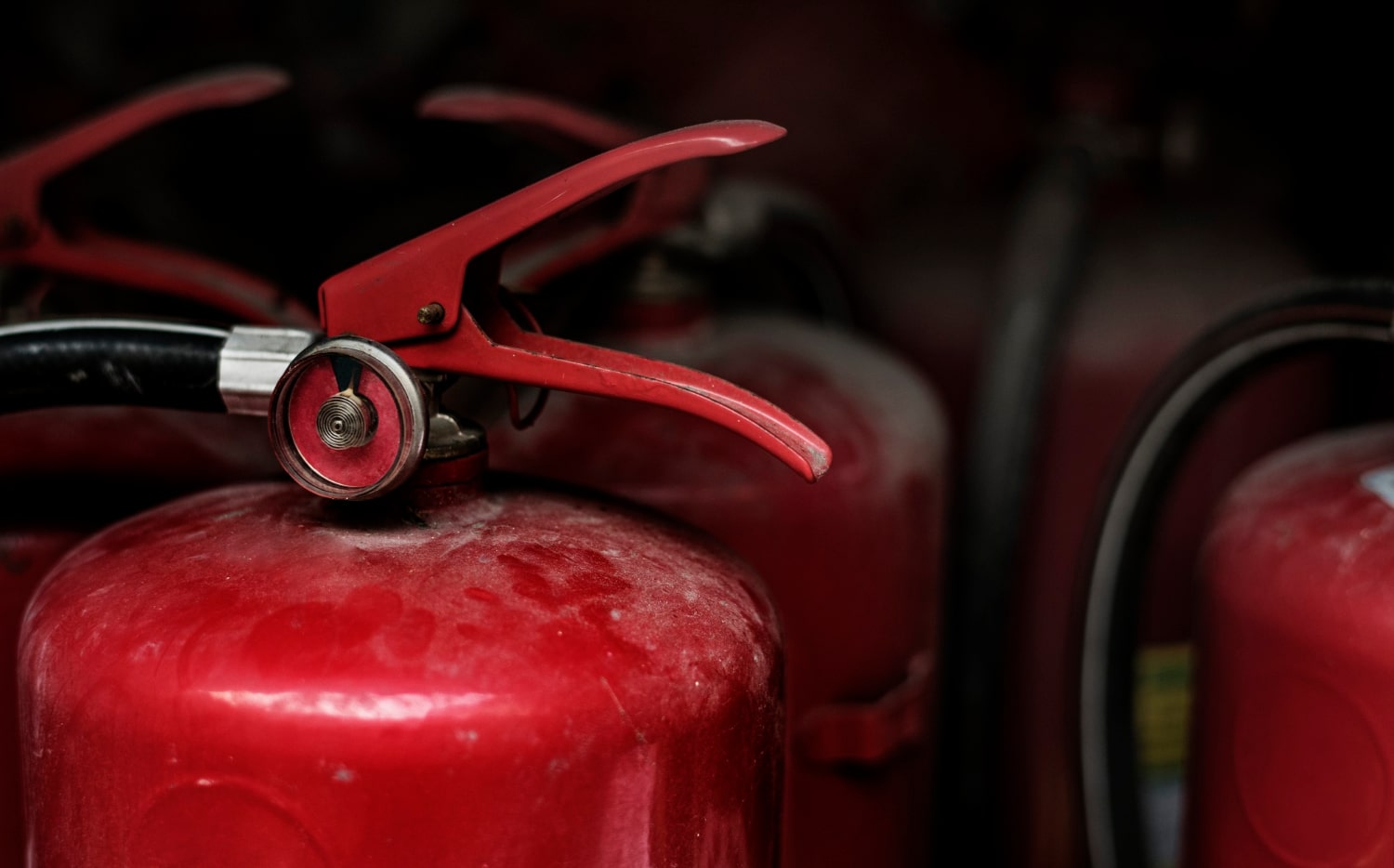
Every portable extinguisher sold in Australia must be red. The coloured band near the top tells you the agent inside and the fire classes it’s rated for. The label confirms the rating and the discharge time. Both have to be legible. A faded or peeled label is itself a defect under AS 1851.
ABE Dry Chemical (white band)
The white-banded ABE is what hangs on most office walls in Sydney. It’s rated for Class A, B and E, which between them cover paper fires, flammable liquid fires and energised electrical incidents. That coverage is why ABE has become the default for offices, warehouses, plant rooms and the common corridors of Class 2 residential stock. The powder breaks the combustion chain by smothering the chemistry of the fire itself.
The catch is what it does after the discharge. ABE leaves a fine powder over everything within range, and on a server rack or patch panel, that powder usually writes off the equipment. CO2 would have done the same firefighting job and left the gear alone.
Undersized units come up regularly. A 4.5kg ABE bolted to the wall of a 1,000 square-metre warehouse isn’t rated for the floor area, and a competent practitioner will mark it for replacement before signing the AFSS. The other recurring defect is powder cake at the base of the cylinder, usually in units that haven’t been inverted during their 6-monthly service. A maintenance failure rather than a design one, but it lands the same way at lodgement.
BE Dry Chemical (white band)
Covers Class B and E only. Now uncommon in NSW because ABE does the same job plus Class A. Still found in some legacy installations, fuel storage areas, and older industrial settings. If you have BE units on the schedule, ask your technician whether ABE would be a more compliant replacement at the next service cycle.
Carbon Dioxide / CO2 (black band)
Covers Class B and E. Discharges as a gas, leaves no residue, and is the standard choice for live electrical environments where powder would cause secondary damage.
Best fit: server rooms, data halls, communications rooms, switch rooms, electrical risers, and any space with addressable detection panels (Notifier, Ampac, Tyco) where a powder discharge would force a board swap.
Avoid in: enclosed spaces with poor ventilation. CO2 displaces oxygen and can asphyxiate the operator. The discharge horn also reaches dangerous cold temperatures and should never be gripped directly.
What turns up on inspection: 2kg units installed where 5kg is appropriate for the equipment served, and missing or unattached horns where staff have used the cylinder as a doorstop.
Wet Chemical (oatmeal band)
Covers Class F and Class A. The potassium-based agent reacts with hot cooking oil to form a soap layer that seals the surface and prevents re-ignition. This is the only acceptable extinguisher for Class F commercial cooking oil fires.
Required within reach of every deep fryer, char grill, and large hotplate in a commercial kitchen. AS 2444 sets a maximum travel distance of 10 metres for Class F, half the 20 metres allowed for A and B.
What turns up on inspection: ABE units mounted in restaurant kitchens because someone substituted on price. Using ABE on a fryer fire can cause the burning oil to splash explosively, spreading the fire across the cooking line. These get swapped out before the kitchen runs the next service.
Foam (blue band)
Covers Class A and B. Forms a blanket over the flammable liquid surface to cut off oxygen and cool the fuel.
Best fit: workshops with flammable liquid storage, vehicle service bays, car parks, and fuel handling areas.
Avoid near live electrical equipment. The foam conducts.
Note on PFAS: older foam formulations contain PFAS and are now restricted under NSW EPA controls. If you have legacy foam units on the schedule, your service technician should be flagging replacement to a fluorine-free formulation as part of the routine inspection.
Water (no band, all red)
Water extinguishers are now rare across Sydney commercial stock. The agent only covers Class A (paper, timber, textiles), and the moment any electrical or flammable-liquid risk enters the picture, the unit becomes a liability rather than a safety measure. Water on a live circuit puts the operator into a shock. On hot oil, it spreads the burning fuel and makes the fire worse.
They still turn up in document stores and the occasional older library or admin building where the original schedule pre-dated the shift to ABE. If you’ve inherited a property with water units mounted near service corridors or IT rooms, that’s almost always a defect waiting to be cited at the next AFSS.
Lithium-Ion Battery Extinguisher
Covers Class A and lithium-ion battery fires. A newer category responding to thermal runaway events in EV chargers, e-bike batteries, mobility scooters, and stationary battery storage.
Standard ABE, CO2, and water units don’t reliably control a lithium-ion fire. The cell generates its own oxygen and reaches temperatures above 1,000°C during thermal runaway. Specialist agents such as AVD (aqueous vermiculite dispersion) or F-500 form a thermal barrier and draw heat from the cell, breaking the runaway cycle.
Required for EV charging bays, battery storage rooms, warehouses handling e-bike or scooter batteries, and data centres with on-site lithium UPS systems. Increasingly written into fire engineering reports for new Class 7 and 8 stock across Western Sydney.
If your premises have any of the above and no lithium-ion-rated cover, raise it with your fire safety practitioner before your next AFSS lodgement.
How AS 2444 Sets Placement and Travel Distance
AS 2444 dictates where each extinguisher goes once the type is settled. Travel distance is the rule most people get wrong. From any point on the floor, an occupant has to be able to reach the correct-class unit inside 20 metres for general Class A and B hazards. Class F drops that to 10 metres, which is why a wet chemical needs to sit within arm’s reach of the fryer line rather than at the kitchen entrance. The measurement runs along the actual walking path, accounting for partitions, doorways and whatever else sits between the occupant and the unit. Straight-line distance doesn’t count.
Mounting height is the next thing inspectors check. Anything up to 4kg can sit with the carrying handle no higher than 1.2 metres off the floor; heavier units drop to 1.0 metres. Plenty of CBD office stock has cylinders mounted at chest height or higher because the wall got refit, and nobody re-measured against the standard.
Then there’s signage. Every unit needs a compliant location sign above it, visible from the normal travel paths and clear of storage, retail fitouts or partition walls. Covered signs are the easiest defect to clear, and they show up on almost every site walk.
What NSW Councils Check When You Lodge the AFSS
The Annual Fire Safety Statement is the council’s confirmation that everything on your Fire Safety Schedule has been inspected against its governing standard by someone accredited to sign it off. For portable extinguishers, that standard is AS 1851, and it sets the inspection routine.
The monthly check is a visual the building’s own staff can do: pressure gauge sitting in the green band, no obvious damage to the cylinder or hose, the location sign visible and the tamper seal intact. The 6-monthly service is where a competent technician takes over, with a performance check, weight or pressure verification against the rating, and a fresh, dated tag attached before they leave. Hydrostatic testing comes around every five years, and depending on the agent, the unit may also be due for a full recharge at the same visit.
What gets statements rejected isn’t usually the inspection itself. It’s missing services on the log. A unit that hasn’t been serviced since 2022 carries forward as a defect against every subsequent statement until it’s resolved. On a pre-lodgement site walk, the rectifications get worked through in the same visit wherever the parts allow, and every unit is re-tagged before the statement is filed.
Common Compliance Failures on Sydney Site Walks
The patterns that come up most often across the 400+ statements lodged each year:
- ABE units mounted in commercial kitchens within reach of the fryer line, where wet chemical is the only compliant agent
- CO2 cylinders missing horns, or with cracked discharge nozzles
- Legacy foam formulations containing PFAS are still listed on active schedules
- Plasterboard mounting with no backing batten, pulling loose under cylinder weight
- Service tags dated 2022 or earlier are still attached as the most recent record
- EV charging areas without a specialist lithium-ion-rated unit anywhere on the schedule
- Location signs blocked by retail fitouts, marketing displays, or stored stock
Most can be cleared on the same visit. Some require a fire engineering review where the building class or use has changed since the original Fire Safety Schedule was issued.
If your AFSS is approaching, or your last inspection report shows defects, send it through. Rectifications get quoted and cleared in the same site visit before lodgement.
Frequently Asked Questions
Who can sign an AFSS in NSW?
Only a competent fire safety practitioner accredited through the FPAS (Fire Protection Accreditation Scheme) for the specific essential fire safety measures listed on the Fire Safety Schedule. The accreditation must cover each measure being signed off.
How often must fire extinguishers be inspected in NSW?
Under AS 1851, every portable extinguisher in NSW needs a 6-monthly service by a competent technician, with the building’s own staff doing visual checks in between. Stored-pressure cylinders go in for hydrostatic testing every five years, and some agents require a full recharge at the same time. If you’re missing tags inside that schedule, the unit becomes a defect against your next AFSS.
What extinguisher is required in a commercial kitchen?
Class F cooking oil fires need a wet chemical extinguisher with the oatmeal band, sitting inside 10 metres of every deep fryer or hotplate. A commercial kitchen also needs an ABE or CO2 somewhere on the line for electrical and dry-goods hazards. ABE-only kitchens are one of the defects that keep coming up across Sydney venues.
Do I need a lithium-ion extinguisher if my building has EV chargers?
Depends on what the fire engineering report and current Fire Safety Schedule call for. New Class 7 and 8 stock going up across Western Sydney includes lithium-ion-rated cover at EV charging bays as standard, and the same applies to e-bike and scooter charging areas in commercial and residential. For existing buildings, the answer is usually yes if the use has changed since the schedule was first issued. Best to raise it with your fire safety practitioner so the schedule can be updated ahead of your next AFSS lodgement.
What happens if my AFSS is overdue in NSW?
The local council can issue fire safety orders and penalty notices, and insurance cover can be affected. Lodge as soon as the inspection and rectifications are complete. Overdue statements move through the system as quickly as the council permits once the paperwork is clean.