Most Sydney apartment owners don’t realise their front door is a fire door. That single knowledge gap is behind more AFSS failures than any other defect we see on site. A self-closer gets disconnected. Someone drills a peephole without checking what the door was tested with. A previous tenant fits a deadlock from the hardware store. None of it looks serious. Each one can hold up the building’s Annual Fire Safety Statement and leave the owners’ corporation facing council fines of up to $4,000 per week while the rectification gets sorted.
What follows covers the regulations, who pays for what when a door fails, what residents are not permitted to alter, and how the annual AS 1851 inspection connects to the AFSS lodgement deadline.
What Actually Makes a Door a Fire Door
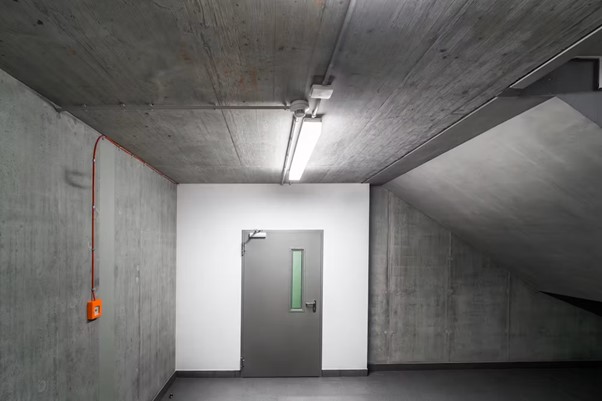
It’s not about weight. It’s not about material. A fire door is a tested assembly, including leaf, frame, hinges, seals, self-closer, and hardware, all certified together under AS 1905.1 to resist the spread of fire and smoke for a specified period. Most apartment entry doors in Sydney are rated to 60 minutes. Stairwell and plant-room doors in older CBD stock often run to 120.
The certification covers the whole system. Change one component to a non-rated alternative, and the assembly is no longer compliant. That’s not a technicality; it’s the reason a plastic peephole drilled through a fire-rated leaf fails an inspection, even if the rest of the door is in perfect condition.
In a typical Sydney apartment building, the following doors are fire doors:
- The front entry door to each lot, where it opens onto a common corridor or fire-isolated stair
- All stairwell doors
- Doors between common areas and car parks, plant rooms, and substations
- Any door listed as a fire safety measure on the building’s Fire Safety Schedule
Not sure whether your front door is fire-rated? Your strata manager can confirm using the Fire Safety Schedule. If the building had its certificate of occupancy issued after the early 1990s and your door opens onto a shared corridor, it almost certainly is.
The Regulations That Govern Fire Doors in NSW
Fire doors in NSW strata buildings sit under four documents, and they all matter.
The EP&A Regulation 2021 is the starting point; it governs every essential fire safety measure, including how the AFSS gets lodged and what happens when it isn’t. AS 1905.1 sets the physical requirements: gap tolerances, hardware specifications, self-closing performance, and certification labelling. AS 1851 determines how often the door gets inspected and what the practitioner checks. From February 2026, AS 1851-2012 compliance became mandatory across all NSW building types except single dwellings.
Sitting across all three is the building’s own Fire Safety Schedule, the document specific to your building that names every essential measure and the standard each must meet. A fire door that doesn’t meet AS 1905.1 on the day of inspection isn’t a compliant fire door, regardless of what it looked like when it was installed.
Who Is Responsible: The Line Between Strata and Lot Owner
Section 106 of the Strata Schemes Management Act 2015 puts it plainly: the owners’ corporation must keep common property in good and serviceable repair. Apartment entry doors are common property for compliance purposes. That means the owners’ corporation funds the annual inspection, addresses wear-and-tear defects, and lodges the AFSS.
Where it shifts is the cause. A frame that’s dropped over 20 years, seals worn from normal use, a self-closer at the end of service life, all common property maintenance, strata’s cost. A non-rated deadlock fitted by the occupant, a plastic peephole drilled without approval, a closer disconnected because someone found it inconvenient, those defects follow the person who caused them.
Since October 2025, NSW Fair Trading has been able to investigate maintenance failures without waiting for an NCAT referral. Binding repair orders with fixed timelines. Fines up to $22,000 for serious breaches. The practical consequence: known fire door defects can’t sit on a deferred maintenance list anymore.
One detail worth understanding is peepholes specifically. A metal-bodied viewer with a penetration of 10mm or less, tested with that specific door model, can be acceptable under AS 1905.1. A plastic-bodied viewer is almost never acceptable, regardless of size. If there’s any doubt about what was fitted and when, the fire safety practitioner will flag it, and the manufacturer’s test record needs to be checked.
What Residents Must Not Do to a Fire Door
These are not suggestions. Each one is a potential inspection failure and a potential AFSS breach.
Do not disconnect or remove the self-closer
The door must self-close and latch under its own power from any open position. In most cases, a closer can be re-tensioned rather than replaced. Speak to the strata manager before touching it.
Do not wedge the door open
Not for move-in day, not for deliveries, not for ventilation. If access is needed for a period, someone stands at the door.
Do not add locks, chains, or deadbolts without strata approval and a fire-rated installation
Off-the-shelf hardware is not fire-rated. A qualified fire door technician using hardware tested with that specific door model is the only compliant path.
Do not paint over the compliance tag
The certification label on the hinge edge is the door’s proof of identity, its brand, its rating, its test reference. A painted-over tag means certification can’t be verified. Replacement tags have to be sourced from the manufacturer, which takes time and holds up the inspection.
Do not drill into the leaf or frame
Any penetration must be assessed against what the door was originally tested with. Drilling first creates a defect that has to be rectified before the AFSS can be signed.
Do not trim the bottom of the door for new flooring without a fire door technician confirming the gap
The base clearance under AS 1905.1 is generally less than 10mm. A new timber floor can close that gap to the point that the door binds and won’t self-close.
What Happens During the Annual Inspection
Under AS 1851, every fire door on the building’s Fire Safety Schedule must be inspected by an FPAS-accredited fire safety practitioner at least every 12 months. A typical inspection on a Sydney apartment entry door takes 15 to 25 minutes.
Gap tolerances
AS 1905.1 requires an average of under 3mm between leaf and frame on the sides and head, and under 10mm at the base. These tolerances vary slightly depending on the door brand and original test sample, which is why manufacturer records matter when peepholes or hardware changes are in question.
Self-closing and latching
The door must close fully and latch cleanly under its own power from any angle. If it needs a push to engage the latch, it fails.
Frame condition
Splits, significant dents, separation from the wall, a dropped frame that’s shifted the door out of square, all recorded as defects.
Hardware
Every item must be fire-rated and compatible with the original test assembly. Mismatched hinges, non-rated cylinders, and aftermarket closers get flagged.
Intumescent and smoke seals
Must be intact and continuous. A missing section, often caused by repainting, is an easy rectification but a failure until it’s done.
Compliance tag
Present, legible, unpainted.
Defects are documented against each door. The owners’ corporation then has a rectification window, typically 30 to 90 days depending on the council and defect severity, before the practitioner can sign the AFSS for that measure.
How Fire Doors Connect to the AFSS
The AFSS is what the owners’ corporation lodges with the council and Fire and Rescue NSW each year. It declares that every essential fire safety measure on the building’s schedule has been inspected, tested, and confirmed to standard, signed by an FPAS-accredited practitioner, displayed in the building’s common area, and submitted on time.
Fire doors are on that schedule in almost every Sydney strata building. A 40-lot mid-rise will typically carry 60 to 80 individual fire doors once you count every lot entry, stairwell, car park level, and plant room. One non-compliant door doesn’t kill the statement outright, but it has to be rectified and re-inspected before the practitioner can sign. Push that past the lodgement deadline and the fines start. Let it lapse long enough, and the building’s insurance position becomes a separate conversation.
Before You Renovate or Update Your Entry
Replacing flooring near the threshold, repainting the door, fitting a new lock, updating the handle, all of it touches a fire-rated assembly. Get written strata approval before:
- Replacing or adding any lock, deadbolt, or security chain
- Fitting or replacing a peephole
- Trimming the bottom of the door for a new floor finish
- When repainting, the compliance tag must be masked and remain fully legible
- Replacing the door itself, any replacement must be a tested AS 1905.1-compliant assembly
The internal face is yours to decorate within reason. The door as a fire-rated assembly is not.
If your building’s AFSS is due in the next 90 days, or fire door defects have been flagged in your last inspection report, send the report through. We’ll cost the rectifications against your building’s schedule and book the inspection before your lodgement deadline.
We work across Sydney strata, CBD high-rises, Parramatta mid-rises, Western Sydney warehouse conversions, and Northern Beaches low-rise walk-ups. Fire doors are the most common defective item we see at every one of them. Get in touch with us.
Frequently Asked Questions
Can I repaint my apartment front door?
Yes, on both faces. Mask the compliance tag on the hinge edge before painting. It must remain fully legible.
Can I install a deadlock?
Only if it’s a fire-rated model installed by a qualified fire door technician using hardware compatible with your specific door assembly. Standard hardware store deadbolts are not compliant.
Who pays if the door fails the audit?
The owners’ corporation in most cases. If the failure was caused by a modification the lot owner made, a non-rated lock, a plastic peephole, a disconnected self-closer, the rectification cost sits with the owner.
The self-closer slams. Can anything be done?
Yes. Most closers can be re-tensioned to close firmly without slamming. Disconnecting it entirely is not an option.
Who is qualified to inspect and certify a fire door in NSW?
An FPAS-accredited fire safety practitioner. Check the FPAA register before engaging anyone for AFSS work.
What if the AFSS is already overdue?
Get an accredited practitioner on site, complete the inspection, rectify defects, and lodge as soon as the statement can be signed. The longer the gap, the greater the exposure, fines from the council and a weakening insurance position.